
Why is polyurea better than epoxy?
Revolutionizing surface protection — Polyurea delivers unmatched flexibility, faster curing, and long-term durability beyond the limits of epoxy.
In the field of protective and industrial coatings, polyurea has rapidly emerged as a next-generation technology, outperforming traditional materials such as epoxy in nearly every aspect of performance and durability. Its combination of chemical innovation, structural flexibility, and environmental safety has positioned polyurea as the preferred choice for industrial, marine, military, and architectural applications.
1. Superior Safety and Environmental Performance
Unlike many epoxy systems that contain higher levels of VOCs (Volatile Organic Compounds), polyurea is a 100% solid, solvent-free, and odorless material. This means it can be safely applied in confined or occupied environments, such as industrial facilities, food processing plants, healthcare settings, and swimming pools, without releasing harmful vapors.
This non-toxic nature makes polyurea not only safer for workers during application but also compliant with modern environmental protection standards.
2. Flexibility and Structural Adaptation
One of polyurea’s most remarkable advantages is its exceptional elasticity. It can expand and contract with the substrate as environmental conditions change — including temperature, humidity, and mechanical stress.
This flexibility prevents cracking, delamination, or failure over time, making it ideal for bridges, ships, and large steel structures that experience thermal expansion and contraction. Epoxy coatings, by contrast, are rigid and prone to cracking under similar conditions.
3. Faster Application and Reduced Downtime
Polyurea’s ultra-fast curing time is a major benefit in industrial settings. It can gel within 5–10 seconds and achieve walk-on strength in under two minutes, allowing full system completion in hours rather than days.
This drastically reduces downtime, labor costs, and operational interruption compared to epoxy, which often requires extended curing periods and controlled environments to reach full performance.
4. Unmatched Chemical and Mechanical Resistance
Polyurea provides superior resistance to chemicals, abrasion, and impact. It withstands exposure to harsh substances like hydrocarbons, acids, alkalis, and solvents commonly found in manufacturing and refinery environments.
In mechanical terms, polyurea maintains high tensile strength and impact absorption while preserving its elasticity. This makes it ideal for refinery tanks, pipelines, secondary containment areas, and marine equipment where both corrosion resistance and toughness are essential.
5. Longevity and UV Stability
Epoxy coatings often degrade under UV exposure, leading to chalking, discoloration, and performance loss. Polyurea, however, offers excellent UV stability, maintaining both color and gloss for many years in outdoor or high-sunlight environments.
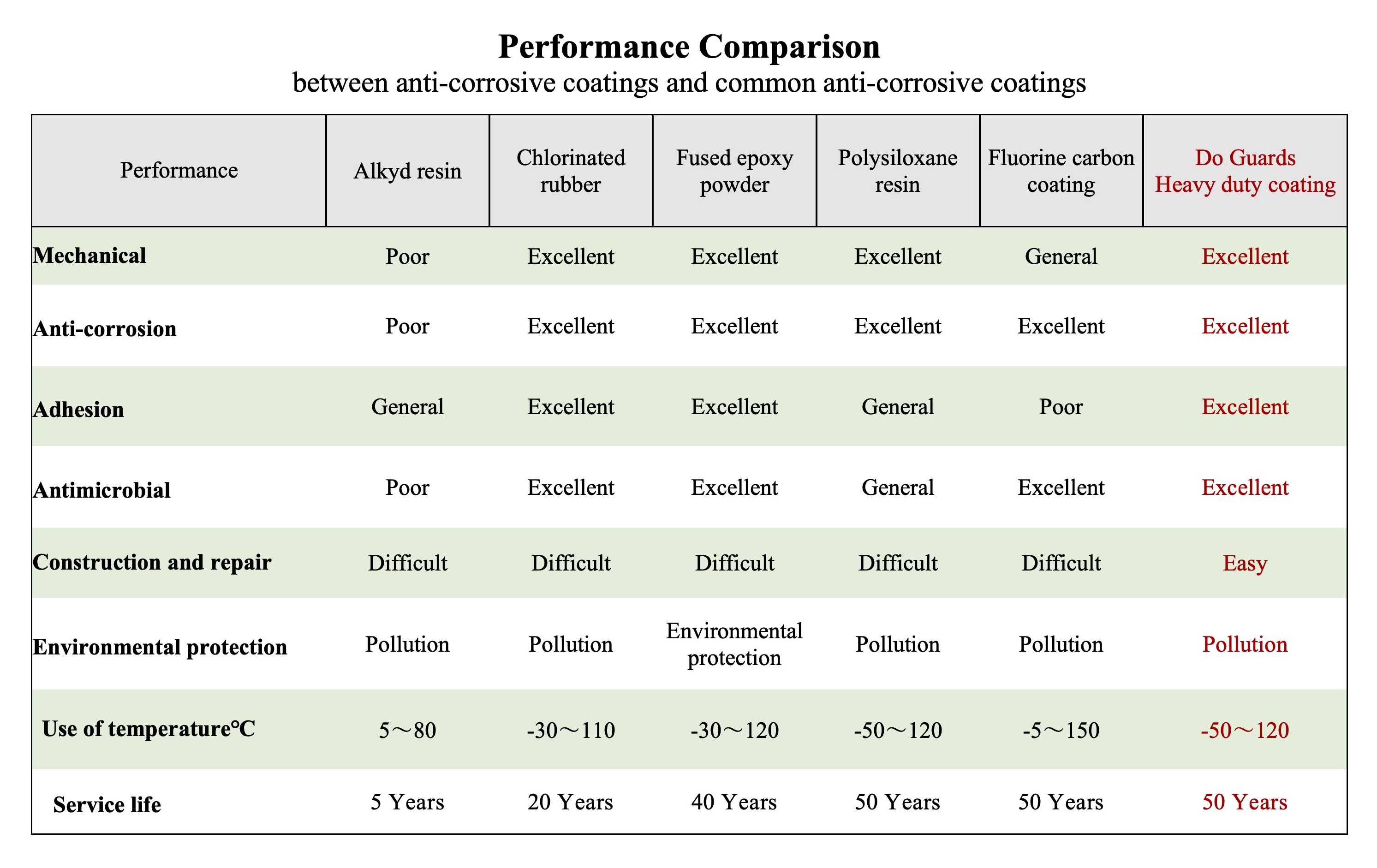
Its service life can reach up to 50 years, significantly outlasting traditional coatings like alkyds or chlorinated rubbers.
6. Comparative Performance Data
A comparative study (see attached table) demonstrates that Do Guards Heavy-Duty Polyurea Coating excels across nearly all technical parameters — including mechanical strength, anti-corrosion protection, adhesion, antimicrobial performance, and ease of construction.
While conventional coatings like epoxy and polysiloxane offer good protection, polyurea delivers a balanced, long-term solution capable of withstanding temperatures from -50°C to +120°C with minimal maintenance.
7. The Future of Coating Technology
As industries evolve toward sustainable, high-performance solutions, polyurea represents the future of industrial coatings — offering speed, safety, and superior protection.
At TCI DO Guards Coating Solutions, our advanced formulations of pure, hybrid, and specialized polyurea systems are engineered to outperform traditional coatings in every aspect — ensuring durability, safety, and long-term value for our clients worldwide.
Gallery